



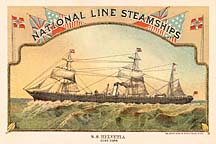
 April 27, 1882: The S.S. Helvetia, a British
 Schulz Family in 3rd Class
Name: Martin J. Schulz |
For those in steerage, the trip, though probably not living up to the company's advertising ("Light and airy, and warmed by Steam in winter..Meals are served regularly three times a day by the Ship's Stewards, and consists of an unlimited quantity of good and wholesome provisions, put on board under the inspection of the Company's Purveyor. Plenty of fresh drinking water. The care of Surgeon and Stewards free.") is still a big improvement over the days of sail: the speedy Helvetia, a Civil-War-era relic originally designed for trips to the former Confederacy, has made it from Liverpool in a week. Nevertheless, 3-year-old Anton Hine of Germany does not survive it and his death is noted with an "X" by the Port Authority.
The Schulz/Beyers are from Westpreussen (West Prussia) on the Baltic Coast, today part of Poland, which in 1882 was a core region of the increasingly powerful German Empire led by the "Iron Chancellor" Otto von Bismarck.
They are part a huge wave of more than a million Germans who came to the U.S. between 1881 and 1885 - more than 10 million in the 19th century - settling mostly in the Midwest. Seen as thrifty, capable, and hard-working, Germans were in high demand. It's thanks to them that we today have kindergartens, hamburgers, hot dogs, and Christmas trees. By 2016 the US Census Bureau estimated the German-American community at 44 million, making them the single largest ethnic group in the country.
The Schulz family's timing was excellent: they largely avoided the First World War from 1914-1918, which killed millions of Europeans and resulted in West Prussia being returned to Poland, and also the Russian invasion near the end of the Second World War, in which Russian soldiers who'd seen their own country destroyed by the Nazis took their vengeance on German civilians in the form of systematic rape and murder. Surviving Germans who'd lived there for generations were expelled to other parts of a shrunken Germany; many were sent to Soviet labor camps like Vorkuta, from which few returned.
 |
|---|
Martin Schulz sees America for the first time with his wife Dorothea Beyer, 3-year-old son Paul, baby Bernhard, his sister Bertha, and his wife's brother and sister August and Augusta Beyer. Martin probably did not know that the current American president, Chester Arthur, had been the Collector of Customs for the very port he was now entering (although he probably did know that Arthur was president because a deranged office seeker had shot his predecessor, James Garfield).
Perhaps little Paul took ill aboard ship or during the family's trip to Michigan. In any event he died a month later in Saginaw, six months before his 4th birthday.(Early death was probably even more common than it seems, as children who were born and died between censuses and polls did not show up at all.) Our ancestor Martha Appolinia Schulz and her twin brother August were born eight months later.
 |
|---|
 |
| Source: New York Passenger Lists, 1882 Click to see full images: Page1 Page2 |
The Schulz's settled in an all-German neighborhood. This was a common practice among immigrants of that time, who often spoke no English and were making a frightening transition from one world to another.
On October 16, 1886 Martin Schulz became an American citizen, swearing "(I) abjure forever all allegiance and fidelity to each and every foreign Prince, Potentate, State or Sovereignity whatsoever, and do particularly and entirely renounce and abjure forever all allegiance and fidelity to the Emperor of Germany of whom, before, I was a subject."
 |
|---|
| Martin Schulz and Dorothea Beyer |
Dorothea died in 1925. Martin lived until 1932. His grandaughter Joyce, who was two when he died, still remembered him almost 80 years later: "He would chase my sister JoAnn and I around the house, teasing us in German. He spoke German when he didn't want us to understand something but actually we understood a lot of it."
More research needs to be done. The History Guide contains excellent indexes to historical material for Europe. Although texts are usually in the native language, most web browsers have an option to translate it to English.
1900: Saginaw Michigan
By the turn of the century day laborer Martin and housewife Dorothea are solidly established in the thumb of Michigan, with nine children.
 |
|---|
| Source: 1990 U.S. Census Click here to see full image |