




Our ancestors may not include a single fugitive from the Irish Potato Famine, which propelled nearly two million Irish to North American shores in the years 1847 through 1851. Our Canadian roots go deeper. Mary Bartlett (b. 1850) and Cecilie Roche (b. 1845) were both born in Ontario. Mary's parents came from New York, not Ireland, and Cecilie was born before the Famine.
|
|
|---|
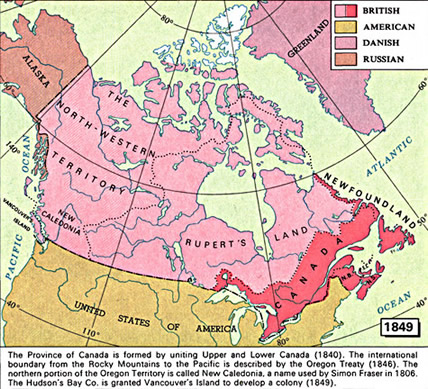
Canadian roots for the McMullins and LaVeques go back at least to 1825, to Ontario and Quebec, respectively. On the paternal side, Mary Bartlett's mother Eliza Riley was born in Canada, probably in eastern Ontario bordering the state of New York, where the Coles originated.
Irish Diaspora 1846 - 1850
Most Irish-Americans of this era came through Canada first because as citizens of the Commonwealth it was much cheaper to emigrate aboard Commonwealth vessels. For example, in 1842 the fare from Belfast to Quebec was £6 while the fare to New York was £21. Another factor was that US ports frequently refused entry to these penniless, starving, disease-riddled emigrants, while the Canadian ports of Quebec and St. John remained open even during the height of the Potato Blight of 1845-1849.
Typically an immigrant vessel - often a timber ship which would have otherwise returned empty - landed in Quebec and its passengers traveled 180 miles upriver to Montreal. Despite attempts by Canadian/British authorities to persuade them to settle in sparsely-populated Canada, most secured free passage up the St. Lawrence and then walked across the US border; in 1843 of nearly 21,000 emigrants, only 300 settled in Canada. The reasons were both economic and political. Labor opportunities abounded in bustling, expanding America with its population of 23,000,000. And, for reasons too numerous to explore here, the Irish had no love for the British Crown and no wish to settle in one of its colonies.
Not that Irish were welcomed with open arms in America--Catholic, penniless, without skills, and often weak from typhus or typhoid, they were generally regarded with aversion and contempt by the predominantly Protestant population. Still, unlimited immigration to the US was the rule until 1921 - unless, of course, you were Asian, an anarchist, crazy, or deemed otherwise degenerate.
An often overlooked element of Canadian emigration to the U.S. are French Canadians like our ancestor Ann LaVeque. Between 1840 and 1930, about 900,000 French Canadians left Canada to emigrate to the United States, mostly to New England. Ann herself came to Michigan with her husband Alexander McMullen in 1877.
Canadian Links
Immigrants to Canada
Emigrant Handbook of 1820
Canadian Geneology and History
Letters
to Encourage Emigration, 1842
Ontario Cemetery Finding Aid Search (OCFA)
Canada Genealogy